
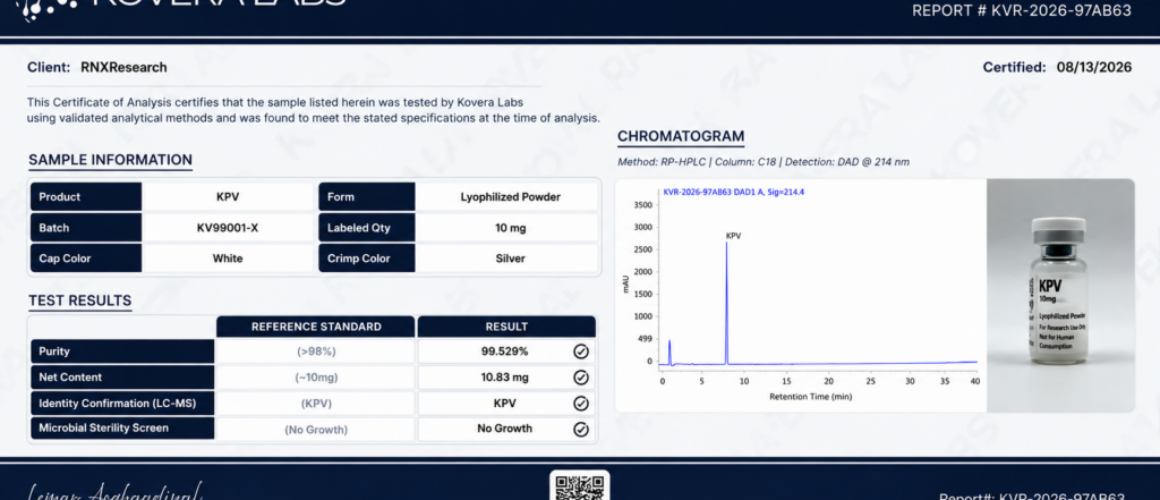
How to Read a Peptide COA: The 3 Core Tests Explained
A Certificate of Analysis is the single most important document in the research-compound space — and most people have no idea how to actually read one. Here’s exactly what the three core tests on a peptide COA mean, what each one can and can’t tell you, and how to know the number you’re looking at is real.
A peptide COA reports three core tests: identity (is it the right compound, confirmed by mass spectrometry), purity (how clean it is, measured by HPLC), and content (how many milligrams of peptide are actually in the vial). No single number covers all three — a legitimate certificate reports each one, tied to a specific lot number, from an independent third-party laboratory.
What Is a Peptide COA?
A Certificate of Analysis, or COA, is a laboratory document that reports the results of testing performed on a specific batch, or lot, of a compound. For research-use-only (RUO) peptides — which are not regulated the way pharmaceuticals are — the COA is your primary quality-assurance tool. Because the burden of verification sits with the researcher, knowing how to read one is essential.
A legitimate COA answers three core questions about the material — and the mistake most people make is assuming one number covers all three. It doesn’t. In the research community, the three tests that form the backbone of any real certificate are identity, purity, and content. Understand these three and you can read almost any COA with confidence.
The 3 Core Tests Every Peptide COA Should Have
These three tests are the foundation of every legitimate Certificate of Analysis. If a COA is missing any of them, it’s incomplete — no matter how professional it looks.
Identity — Is It the Right Compound?
Identity testing confirms that the material in the vial is actually the compound named on the label. It’s the most fundamental question a COA can answer: is this even the right molecule?
Identity is typically established by mass spectrometry (LC-MS or LC-MS/MS), which measures the molecular weight of the compound and confirms it matches the known mass of the target peptide. Some certificates also use FTIR (Fourier-transform infrared spectroscopy) to confirm the characteristic molecular “fingerprint” bands of the compound.
Here’s why identity matters more than people realize: purity and identity are completely independent. A sample can test extremely clean — 99% pure — and still be 99% pure of the wrong peptide. Purity tells you the sample is uniform; only identity tells you it’s uniform of the correct molecule. This is why a COA that lists a purity percentage but has no identity confirmation is such a serious red flag — it’s proving the sample is clean without proving it’s the thing you ordered.
Purity — How Clean Is It?
Purity is the number everyone quotes — the HPLC (high-performance liquid chromatography) percentage, usually listed as 98%, 99%, or higher. It’s the most talked-about figure in the entire space, and also the most misunderstood.
Here’s what HPLC actually does: it separates all the components in a sample and measures how much of the total is the target peptide versus everything else — truncated sequences, synthesis byproducts, and other impurities. A 99% HPLC purity means 99% of what’s in the sample is the intended peptide and 1% is other material.
But purity has hard limits on what it can tell you. It measures how clean the sample is — nothing more. It does not confirm the compound is correct (that’s identity), and it does not tell you how much peptide is actually in the vial (that’s content). This is the single biggest misconception in the space: people treat the purity percentage as an overall “quality score,” when it’s really just one of three separate measurements. A high purity number on a COA that’s missing identity or content is far less meaningful than it appears.
One practical tip: look at the chromatogram itself, not just the percentage. A real HPLC readout shows a dominant peak for the target compound plus small secondary peaks and some baseline noise. That’s what real data looks like. A single perfect spike with a flat, noise-free baseline can be a sign of a fabricated result.
Content — How Much Peptide Is Actually There?
Content — also called net peptide content, mass content, or sometimes potency — tells you how many actual milligrams of the peptide are in the vial. It’s the “am I getting what I paid for” number, and it’s the one that’s most often missing or glossed over on weak certificates.
This test matters because of a subtle trick: net weight is not the same as peptide content. A lyophilized peptide vial doesn’t contain pure peptide — it also contains counter-ions (salts like acetate or TFA) and residual water bound up in the powder. All of that adds weight. So a vial can weigh exactly what the label says by total mass, while the actual amount of peptide inside is meaningfully less.
Content testing cuts through that. It reports the real peptide mass, so you know a “10 mg” vial genuinely contains 10 mg of peptide — not 10 mg of powder that’s part salt and water. Without a content figure, you’re trusting the label’s weight and hoping the salt-and-water fraction is small. With it, you have an actual measured number — which is why every published RNX certificate reports peptide content, not just purity.
Purity vs. Potency vs. Identity: Why They’re Not the Same
If you take one thing from this guide, make it this: identity, purity, and content are three different questions, and no single number answers all three. They’re often confused with each other, but each measures something the others can’t.
- Identity — is it the right compound? (mass spec / FTIR)
- Purity — how clean is it? (HPLC %)
- Content — how many milligrams are really there? (assay)
A vendor showing you only a purity percentage is showing you one-third of the picture. The strongest certificates report all of it — tied to a specific lot number, from an independent laboratory.
What a Strong COA Looks Like
The best certificates share a few things in common. They’re issued by an independent, third-party laboratory — not tested in-house by the seller, which is a conflict of interest. They carry a lot or batch number that ties the document to the specific product you received. They report a report or reference number you can use to verify the certificate with the issuing lab. And they’re publicly viewable — you shouldn’t have to buy first to see one.
Beyond the Core Three
The three core tests are the foundation — but thorough testing programs can go further. Depending on the compound and its intended research use, some certificates add sterility testing (screening for living contaminants like bacteria, yeast, and mold), bacterial endotoxin testing, heavy-metal screening, or residual-solvent analysis. These add real depth, and sterility in particular is one of the most valuable additions a vendor can make. Once you know the core three, the next steps are learning how to spot a fake COA and how to verify a COA is real.
But the principle holds: the three core tests come first. If a certificate doesn’t cover identity, purity, and content, more exotic tests don’t make up for the missing basics. Master the three, and you can evaluate any COA you’re handed.
See what a complete COA looks like
At RNXResearch, every batch is independently third-party tested and the certificates are published openly for anyone to read — the standard the whole space should hold.
View the COA libraryFrequently Asked Questions
What is a peptide COA?+
What does HPLC purity mean on a COA?+
Is purity the same as potency?+
What are the three core tests on a peptide COA?+
Does a COA prove a peptide is sterile?+
For laboratory research use only. Not for human or veterinary use. Not for human or animal consumption. Not for diagnostic, therapeutic, or clinical use. No statement on this page has been evaluated by the Food and Drug Administration.